
Facelift
Lifting/Tightening of the Face
What is a Facelift?
This procedure represents a top-tier surgical aesthetic intervention that delivers revolutionary results in the fight against aging. It effectively lifts and tightens the skin, tissues, and facial muscles, achieving the desired youthful appearance.
Why choose a facelift?
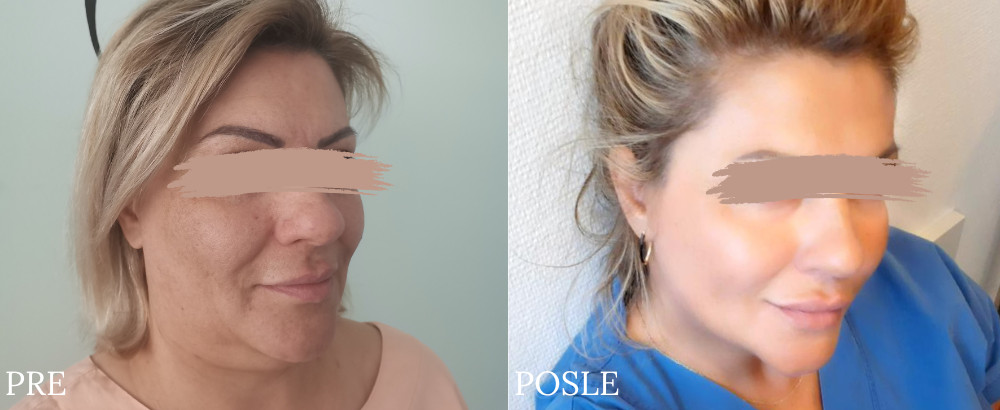
As we age, our skin loses elasticity; fat deposits increase in some areas of the face and decrease in others, changing the overall facial shape. A facelift can achieve the following effects:
Tightens sagging cheek skin
Eliminates excess skin in the jawline area
Reduces deep nasolabial folds
Lifts the forehead area, resulting in elevated eyebrow corners
It is important to note that a facelift will not remove fine lines, wrinkles around the nose and above the upper lip, sunspots, or uneven skin tone.
How is a facelift performed?
Preparation for facial tightening
During the pre-operative consultation, the surgeon will explain where the incisions will be made and what results can be expected. The doctor will determine how the facelift will be performed based on skin condition, skin thickness, fat distribution, and facial shape. The surgeon will also mark the lines along which incisions will be made and take photos of your face for comparison after the facelift.
Facelift surgery procedure
Facelift surgery is performed under general anesthesia or short-term intravenous analgosedation.
In a facelift, the incision is made at the temples along the hairline, then just in front of the ears, under the earlobes, and behind the ears along the lower scalp. Sometimes a limited incision facelift is performed, which does not include an incision along the lower scalp. The skin is lifted and the underlying tissues and muscles are tightened. Fat deposits beneath the skin can be removed, reshaped, or repositioned to achieve new facial contours. Excess skin is removed and the incisions are closed.
The facelift surgery lasts between 2 and 4 hours. The duration depends on the type and extent of the procedure.
Recovery after facelift surgery
The first check-up, removal of bandages and drains is done 2 days after the surgery. At that time, you can start wearing an elastic facial strap instead of the bandage. Other follow-up appointments are scheduled in agreement with your doctor. Stitches are removed between the 7th and 10th day.
During the first few days, you may experience moderate pain that subsides after taking the pain medication recommended by your doctor. Swelling, bruising, and a feeling of tightness may also occur. To reduce swelling and bruising, it is recommended to sleep with your head elevated and to apply cold compresses.
During the first three weeks:
Do not remove scabs that form during the wound-healing process.
Take care of the wound as instructed by your surgeon.
Wear clothing that does not pull over your head.
Avoid wearing makeup.
Avoid strenuous physical activity.
Do not dye your hair, bleach it, or get a perm for at least 6 weeks after the facelift.
- Avoid direct sun exposure and do not use tanning beds. Later, always apply a high SPF sunscreen (SPF over 30) and wear dark sunglasses.
How to prepare for facelift surgery?
On the morning before the facelift surgery, it is necessary to wash your face and hair with antibacterial soap/shampoo.
You must not eat or drink anything 6–8 hours before the surgery. You may take your regular chronic medication with a sip of water.
If you are taking blood thinners (such as warfarin), aspirin, vitamin C, other supplements, or anti-inflammatory medications (ibuprofen, diclofenac), you should stop taking them at least one week before the surgery to reduce the risk of bleeding and bruising.
Which procedures combine well with a facelift?
Maximum results are achieved when facelift surgery is combined with chin liposuction and surgical neck lift.
Are there any risks and unwanted outcomes?
It is important to note that facelift complications are very rare. Swelling, bruising, and facial numbness are temporary. Sometimes, hypertrophic scars may form behind the ear, and the hairline may shift. In extremely rare cases, permanent alopecia (hair loss around the incision site in the scalp area) may occur.
As with any surgery, there are risks of bleeding and infection, but these are minimized when performed in a fully sterile operating room by an experienced surgeon strictly following protocol.
Before and After
FAQ
How long does recovery take?
Recovery is relatively short. The first follow-up visit is 2 days after the surgery, and stitches are removed between the 7th and 10th day. Most patients can return to daily activities after two to three weeks, although swelling and bruising may persist longer. It is recommended to avoid strenuous activities and carefully follow the surgeon’s post-operative instructions.
What are the recommendations during recovery?
It is recommended to wear an elastic band, avoid physical exertion, direct sun exposure, and applying makeup during the first three weeks.
When will I see the final results?
Final results become visible after swelling and bruising subside, which usually takes a few weeks.
How long do facelift results last?
Facelift results can last ten years or more, but the natural aging process will continue. Regular check-ups and maintaining a healthy lifestyle can help extend the longevity of the results.
Which areas can be treated with a facelift?
A facelift can be performed on different parts of the face and neck, including the forehead, cheeks, around the eyes, jawline, and neck. The procedure is customized to each patient’s individual needs.
Can a facelift be partial?
Yes, a facelift can be partial, known as a mini-lift, where only a specific area of the face is treated, such as the upper, mid, or lower face, or just the neck.
What types of partial facelifts exist?
Partial facelifts include:
- Brow lift
Temporal brow lift
Midface lift
Neck lift
What signs of aging can be corrected with a facelift?
Signs of aging include forehead wrinkles, sagging cheeks, nasolabial folds, wrinkles around the eyes and mouth, and loose skin on the neck and under the chin.
Is eyebrow lifting possible as part of a facelift?
Yes, eyebrow lifting is a common part of a facelift. The goal is to place the eyebrows in a natural and refreshed position, rejuvenating the appearance of the face.
Can a facelift be done on the neck?
Yes, neck lifting is often part of the complete procedure. This intervention removes excess skin and tightens the muscles, restoring the definition of the jawline and neck.
What results does a forehead lift provide?
A forehead lift removes horizontal and vertical wrinkles, reduces excess skin, moderately lifts the eyebrows, and ensures a youthful appearance. The result is a smooth and tightened forehead.
Is anesthesia required for a facelift?
A facelift is most often performed under general anesthesia, but partial procedures such as eyebrow lifting can be done under local anesthesia.
Who is an ideal candidate for a facelift?
Ideal candidates are individuals between the ages of 45 and 55 with elastic skin and good overall health. However, the procedure can be adapted to younger or older individuals depending on their needs.